⚙️ This Week Was (Is*) a Vulnpocalypse. 3 Ways GRC Can Help.
A playbook for GRC people helping their security teams through this week, from GRC's own lane: compliance, third-party risk and the risk register.
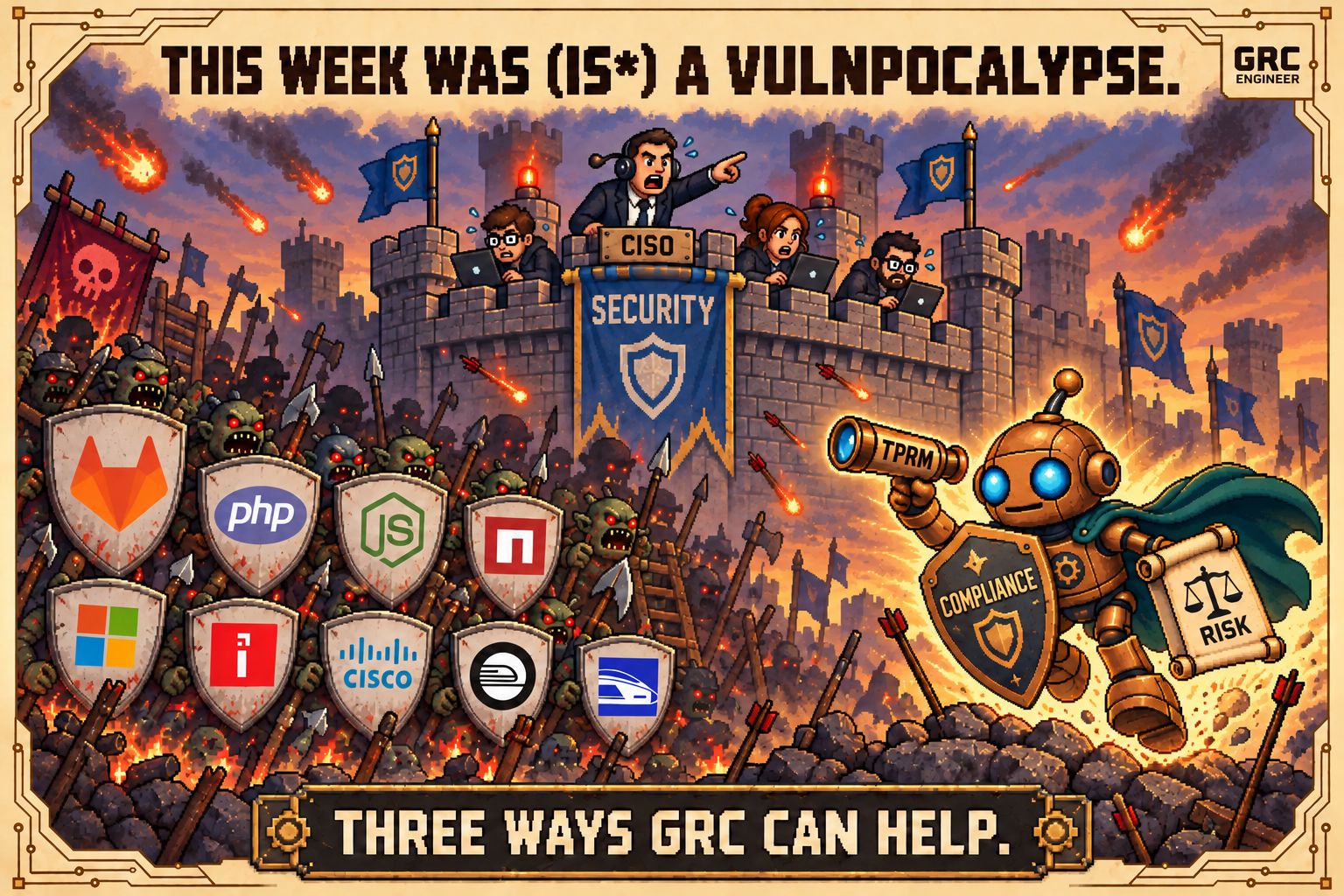
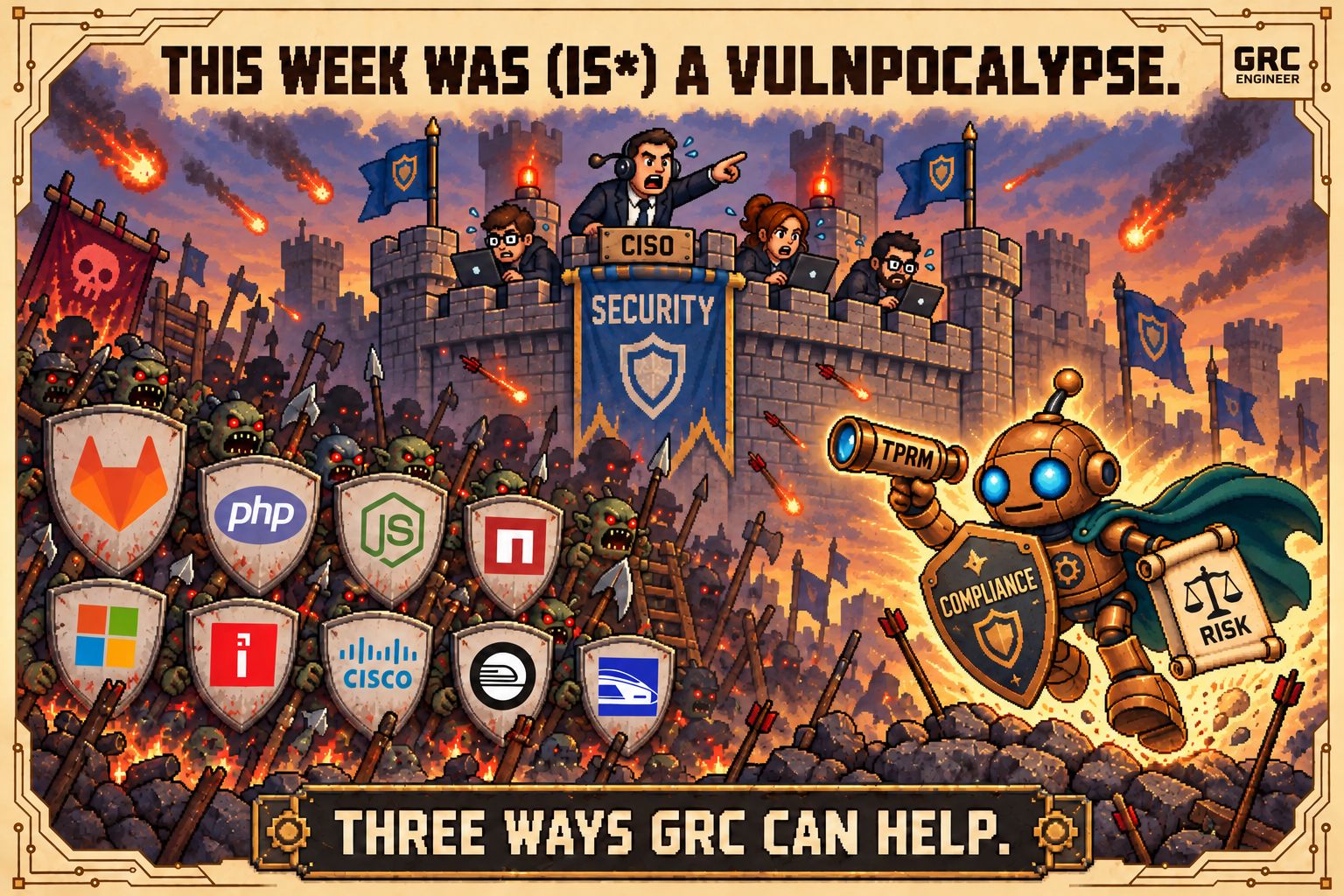
Your security feeds spent the week reading like an incident channel. GitLab patched a CVSS 10 flaw reaching back to 2014, PHP shipped emergency fixes while the NSA advised taking unpatched systems offline, and a record Patch Tuesday was still being absorbed.
*Is, because it's still going as you read this.
That's fifteen headlines in ten days. Most came through a door someone had approved, and most of the breaches started with a stolen or long-lived credential.
The security team is the one living through this. GRC works on different things, like passing audits and holding the programme to its remediation timelines, and that's where it can help this week: compliance, third-party risk and the risk register.
IN PARTNERSHIP WITH
What should AI own in TPRM? (And what shouldn’t it?)
Most TPRM hours go to logistics: chasing attestations, reading SOC 2 reports, parsing questionnaires.
On Nov 4, join a panel of GRC experts as they walk through where multi-agent AI can take that work off your plate, how to tier vendors by actual risk, and which calls should stay human.
Two numbers worth keeping
Microsoft's October 13 Patch Tuesday fixed more than 1,400 CVEs, a record. One of them, a Windows Shell Mark-of-the-Web bypass, was actively exploited, and CISA gave US federal agencies three days to fix it.
The second number comes from Google Threat Intelligence Group, reported by Help Net Security. Monthly vulnerability disclosures rose from 5,045 in January to 10,740 in August 2026.
Of all the vulnerabilities disclosed in 2026, only 0.23% were observed exploited in the wild. That is about one in 431.
Put the two numbers side by side, then look at your remediation SLA. Monthly disclosures more than doubled between January and August, and only a small share of them has been seen in use against anyone.
At this volume, a flat SLA for every critical will be missed, and every miss is risk you're carrying without a decision behind it.
GRC owns that SLA. If your policy says 14 days for every critical, it was probably set before monthly disclosures doubled.
This month, that SLA's evidence will mostly be a list of misses, and it won't tell anyone which miss was the exploited Patch Tuesday flaw. Rank by exploitation first, starting with CISA's Known Exploited Vulnerabilities list, and the SLA tracks the flaws that actually matter.
Your week, in one scroll
What | What happened | Door |
|---|---|---|
CVSS 10 RCE, versions back to 2014 | Core developer platform | |
Edge appliances | Ivanti, PAN-OS, Cisco, BeyondTrust zero-days exploited | Edge appliance |
Publishing trust flaw, 1,500+ packages exposed | Registry trust | |
Critical RCE, NSA says patch or go offline | Language runtime | |
10 CVEs, including RCE | Language runtime | |
Backdoored release via stolen OAuth tokens | Official release | |
Binaries swapped for a secret stealer | Developer account | |
Official packages backdoored, exploited | Official release | |
Fake workflows steal Actions secrets | Developer account | |
Vendor app credential abused in M365 tenants | Vendor app identity | |
Env vars may have been accessed, some decrypted | Platform holding your secrets | |
Plaintext admin creds, now shutting down | Platform holding your secrets | |
Saved AI provider API keys exposed | Platform holding your secrets | |
Stolen service-account creds, billing data exposed | Platform holding your secrets | |
8 CA keys recoverable, one root removed | Certificate authority |
Official releases, package registries, a vendor's own app identity and a certificate authority are the channels your controls are built to trust. This month attackers came through several of them, and two more, a certificate authority and npm's publishing trust, turned out to be breakable.
The vulnpocalypse phrasebook
Every incident week produces the same sentences in the meetings GRC sits in. Keep this open for the ones you'll hear next week.
What you'll hear | What it means |
|---|---|
"Are we affected?" | Nobody knows what runs PHP. |
"It's a CVSS 9.8." | A number, still waiting for a decision. |
"We have a compensating control." | The WAF, probably. |
"Raise an exception." | Expiry date: never. |
"Patch all criticals in 14 days." | A policy written for a quieter year. |
"We did a vendor review." | A snapshot, taken before this week. |
"Let's take this offline." | For once, the NSA said it first. |
"Who owns this?" | The oldest open item in the risk register. |
"We're monitoring the situation." | Someone has the news tab open. |
GRC can help in those meetings without running the patching, through three lanes it already owns.
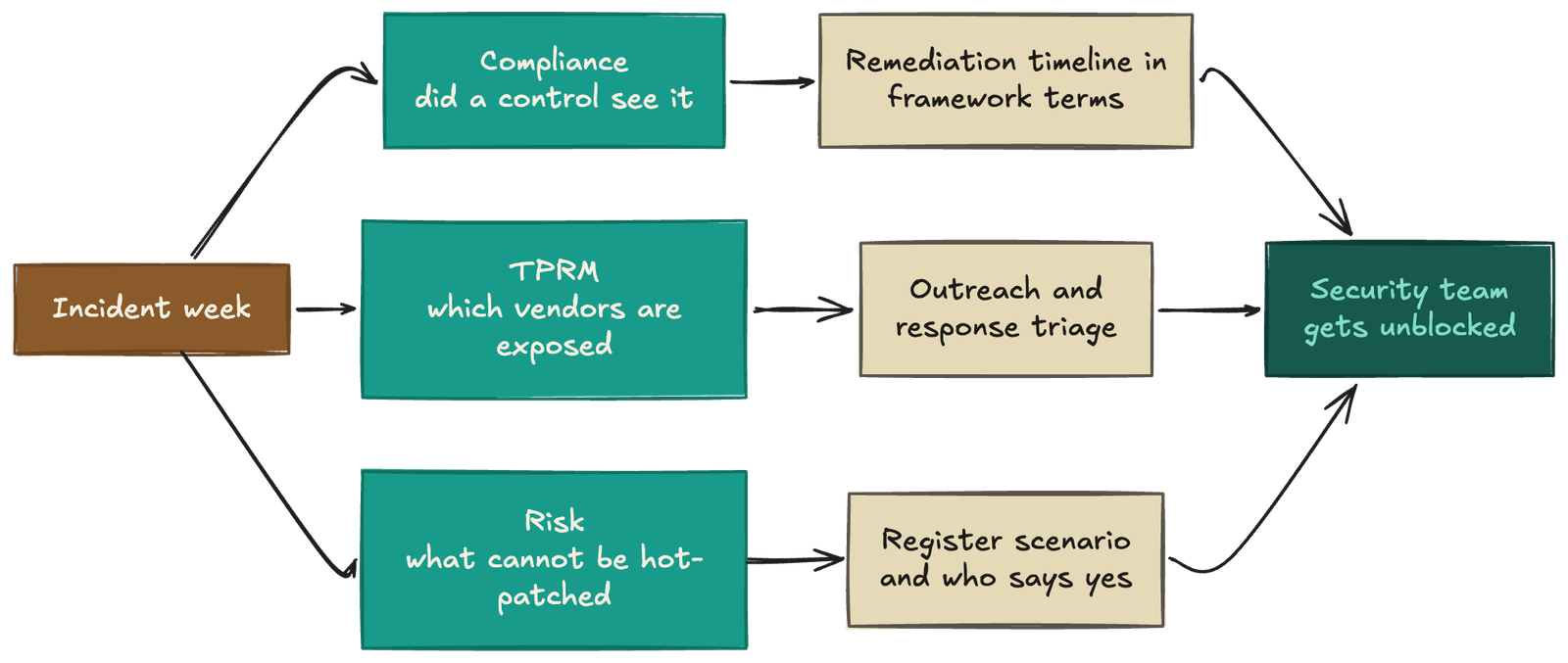
From incident week to something the security team can use, one lane at a time.
Compliance: would your controls have seen it?
Start with the controls whose assets and scope match the components in this week's table. If PHP or Node.js runs inside your certification scope, some control already claims to cover it. In the infrastructure-as-code guide, I showed how a resource can vanish from drift detection while it keeps running, so check what runs as well as what the repo declares.
Then ask: would that control, as designed, have found this?
If your continuous control monitoring works, it should be showing you a failing control right now. The other possibility is that another team saw it first and fed it back to you.
If GRC learned last, ask two follow-up questions: should you have been aware, and is this something you need to track?
If you found out from Slack, the control didn't do its job.
In the issue on certification scope, I walked through a team shipping 100 times a day, where the auditor samples 25 of roughly 36,000 pull requests, about 0.07%, while the certification covers all of them. Weeks like this one are when you find out how the rest are doing.
Then do GRC's part, which sits one level up from the flaw: the commitments your programme has made.
Give back remediation timelines in the terms those framework commitments use. That means the vulnerability management control in your SOC 2 or ISO 27001 programme, and FedRAMP 20x if you run one. For each in-scope component, write one line: the finding, the SLA your policy commits to, the due date, and the exception if you will miss it.
TPRM: map your vendor exposure
When vendors have a week like this, think about every vendor you have, beyond the names in the table.
Check your own company first. Do you use any of these libraries, frameworks, languages or services directly? If the answer is yes, that component goes to your security team and back into the scope check from the compliance lane.
For vendors, check the subprocessor lists on their trust centres. Then read their DNS records to see which services they rely on, and work out from both whether you have exposure.
A verification record in TXT or a mail provider in MX shows some of the SaaS and hosting a vendor relies on before you send a single email. DNS won't show which runtime or package they run, which is what the outreach is for. It is the same habit as reading a config with a GRC question in hand.
# generic DNS check, example.com only
# TXT verification records and MX/CNAME targets often reveal which SaaS services a domain relies on
dig +short TXT example.com
dig +short MX example.com
dig +short CNAME status.example.com   # vendor subdomains like status or help are where CNAMEs show up
Then reach out. Weigh how strong the risk is by how much of your data each vendor holds and what access they have to your internal systems.
Decide the best way forward for each one. Ideally, build an automated way to run the outreach and triage the answers as they come back. Next time, you start from this list.
# illustrative vendor response triage
- vendor: vendor-a
  data_held: customer records
  internal_access: SSO app with directory read
  exposed_component: Node.js
  response: mitigated
  follow_up_by: 2026-10-29
- vendor: vendor-b
  data_held: marketing contacts
  internal_access: none
  exposed_component: PHP
  response: patched
  follow_up_by: none
- vendor: vendor-c
  data_held: source code
  internal_access: CI integration
  exposed_component: LiteLLM
  response: no_response
  follow_up_by: 2026-10-23
- vendor: vendor-d
  data_held: support tickets
  internal_access: Microsoft 365 app identity
  exposed_component: none found
  response: not_affected
  follow_up_by: 2026-10-29   # verify: same access path as this week's app-identity incident
Then read the replies as a set. Count who answered and who didn't, who said they mitigated, who said they patched and who said they had acted before the news broke.
Chase the vendors with internal access who haven't answered first. A patched from a vendor holding marketing data can wait.
Risk: the dependency you cannot hot-patch
Look for one scenario in your register. A core dependency used by software in production carries a critical vulnerability, and you cannot hot-patch it fast.
Sometimes the patch exists and still needs proper regression testing before it ships. A language runtime like PHP or Node.js is the example from this week's table.
You need to understand that scenario and have it in the register, with an owner, the interim mitigation and the date the decision gets revisited.
At one in 431, much of the queue can wait. The few flaws that cannot wait and also cannot be patched quickly are the risk register's job. Every interim mitigation on them needs an expiry, either a date or an exposure trigger.
In the risk register issue, I wrote that every row in a register is a photograph of its inputs on one date. This week changed that photograph for any row that depends on PHP or Node.js.
Writing the scenario down is the easy part. Getting it fixed is where GRC's stakeholder management helps the security team most.
Security has to collaborate with many stakeholders to get a remediation moving. GRC can open those doors for them.
You know the right point of contact in each team and who is most likely to get a change through. You also know who has been the security team's biggest ally in the past.
In the vendor dinners issue, I argued that the biggest security decisions still run on gut feel, vendor dinners and whatever leadership read last week. Knowing who actually says yes is how you work with that.
You've built those relationships over the years. This is the week to use them to turn a register entry into a fix in production.
Your security team knows what needs fixing. You can tell them who will get it through.
For the runtime scenario, the list can be this short:
Role | For this scenario |
|---|---|
Remediation owner | Head of platform engineering |
Approver | The risk owner named in the register |
Teams to bring in | Platform, engineering leads, product |
If a vendor is involved | Legal or vendor management |
Ally | The engineering lead who has unblocked security before |
Interim mitigation | Agreed with the remediation owner and written into the register entry |
Revisit by | A date, or the day the flaw appears on an exploited list |
Hand that table to your security team before they need it, and make the introduction to the ally yourself.
Your starter toolkit
If you want | Start with |
|---|---|
Prove a control operates | 5 metrics that prove a control works, with remediation velocity at median and p90 per severity, plus exception age |
Check a platform's testing logic | The Zillow effect in GRC, on platforms moving from storing evidence to judging whether controls work, and what to check in their testing logic |
Keep exceptions tied to exposure | Threatify your GRC workflows, where an acceptance ends when its exposure changes |
Debug a control that failed | The GRC debugger, for finding the frame that broke without booking a meeting |
Before the next one
You don't need the whole playbook this week. Pick the lane where your programme is weakest and do that one before next Thursday.
Try this week
Compliance: pick the control whose scope covers one component in the table and check whether it would have flagged it.
TPRM: list your vendors with the most internal access and check their subprocessor lists for this week's names.
Risk: write the scenario for one production dependency you could not patch within your SLA without regression testing.
Risk: name the people who can get one remediation moving fastest, and introduce your security team to them.
Reply with the phrase you heard most this week haha.
Ayoub
That’s all for this week’s issue, folks!